|
|
|
|
SUSTAIN-6G Newsletter | Issue 2
The second SUSTAIN-6G newsletter highlights the project’s achievements to shape a sustainable and socially responsible 6G future after almost one year of project running. As the European SNS JU Sustainability Lighthouse project, SUSTAIN-6G is developing a holistic framework to integrate environmental, societal, and economic sustainability into next-generation networks and key vertical scenarios. The newsletter covers a wide range of activities, from high-level strategic insights with Christoph Schmelz (Nokia & Project Coordinator) to practical innovations such as telemedicine frameworks for remote rehabilitation using Augmented Reality and AI from Politecnico di Torino and MDCreate. It also showcases the project’s presence at major events like EuCNC & 6G Summit 2025 and CW TEC 2025 - and the upcoming PHOTOPTICS 2026 workshop, demonstrating both thought leadership and hands-on contributions to the 6G ecosystem. Readers will also find updates on cross-cutting initiatives that embed sustainability into technical design, policy, and societal engagement. Highlights include the last plenary meeting in Athens, clustering workshops at Sustainable Places 2025, webinars and workshops on sustainability methodologies, and the project External Advisory Group meeting, all reinforcing collaboration and knowledge sharing across partners and stakeholders. By featuring real-world use cases, research advances, and policy guidance, the newsletter provides a comprehensive view of how SUSTAIN-6G is advancing innovative, inclusive, and sustainable 6G networks—encouraging readers to explore, learn, and engage with the project’s ambitious roadmap. |
SUSTAIN-6G project introduction: a Lighthouse ProjectSUSTAIN-6G, the Lighthouse Project within the European SNS JU, promotes holistic sustainability in 6G by addressing six key objectives. It maps the 6G landscape, compiles state-of-the-art solutions, and identifies sustainability needs. The project defines goals, integrates 6G with vertical use cases to reduce environmental impact, and develops a Sustainability Management Plan (SMP). It also validates sustainable 6G technologies and provides guidelines for future development. |
• Bouchet, O., Legouable, R., Redieteab, G., Vercasson, G., Barmpounakis, S., & Chiaroni, D. (2025). Optical Wireless Communication (OWC) between smartphones with LED/Camera pair (1.0). Zenodo. https://doi.org/10.5281/zenodo.17569841
• T. Feys, L. Van der Perre and F. Rottenberg, "Learning to Quantize and Precode in Massive MIMO Systems for Energy Reduction: a Graph Neural Network Approach," in IEEE Journal of Selected Topics in Signal Processing, doi: 10.1109/JSTSP.2025.3594299.
|
SUSTAIN-6G will be featured at the PHOTOPTICS 2026 conference in Marbella, Spain (6–8 March), through the workshop “Photonic Technologies for a Sustainable ICT – PT-Sustain-ICT”. Co-chaired by Dominique Chiaroni (Nokia Bell Labs), Leif Katsuo Oxenløwe (DTU), and Olivier Bouchet (Orange), the session will bring together leading EU projects, including SUSTAIN-6G and GreenCOM, to explore how optical technologies can enable sustainable ICT. The workshop will cover innovative approaches from low-energy transceivers and Optical Wireless Communications to PON/POL networks and quantum technologies, highlighting how photonics can drive environmentally, socially, and economically responsible next-generation networks. More information at: https://photoptics.scitevents.org/PT-Sustain-ICT.aspx |
Next year in Malaga, Spain, the SUSTAIN-6G project will again host a booth to continue showcasing its progress and engaging with the community. Joining next year's theme, "6G, Connecting Intelligence," the project will build on its previous contributions by presenting the latest advancements in sustainable 6G technologies and their real-world applications. |
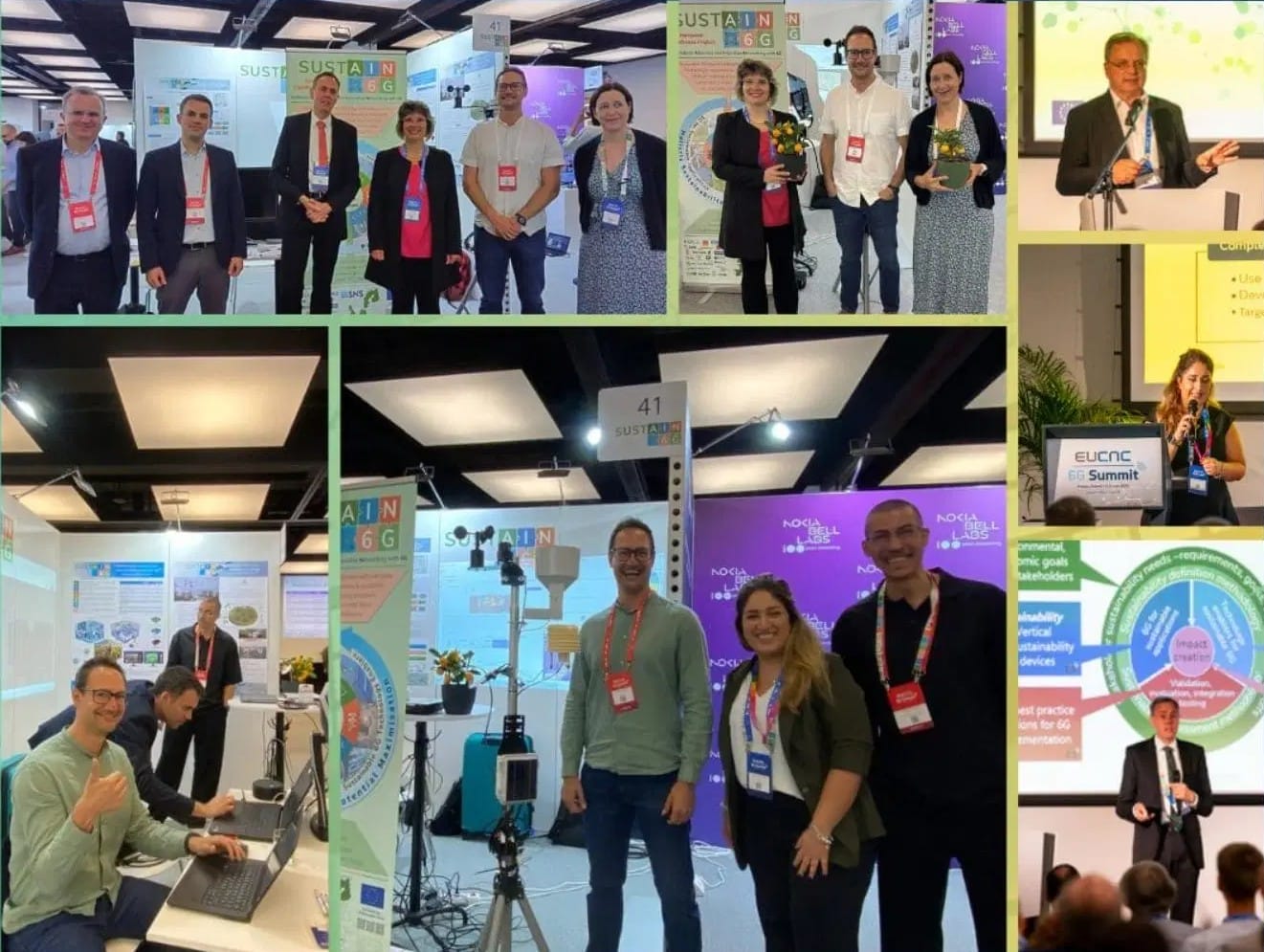
Last year, the SUSTAIN-6G project played an active role in advancing the conversation on sustainable 6G at the EuCNC & 6G Summit in Poznan, Poland. The project contributed through workshops, panels, and demonstrations that highlighted its holistic sustainability framework, covering environmental, societal, and economic dimensions. Partners presented use cases in connected agriculture and environmental sensing, discussed sustainability impact assessment and Key Value Indicators, and addressed the social and policy implications of future networks. The project’s presence helped reinforce alignment on sustainability goals within the 6G ecosystem and encouraged collaboration toward standardisation and responsible technological development. |
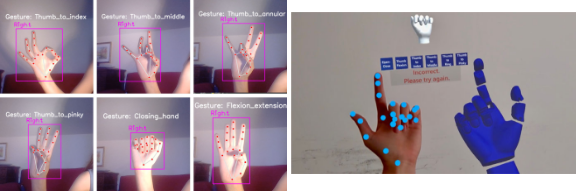
Politecnico di Torino and MDCreate, as part of the SUSTAIN-6G project, are developing an innovative telemedicine framework for remote rehabilitation, focusing on patients with Phantom Limb Pain (PLP). Leveraging Augmented Reality and real-time AI supervision, the system digitally mirrors healthy limb movements to replicate and enhance traditional mirror therapy, enabling personalised rehabilitation at home. The Proof of Concept aims to evaluate performance, usability, and latency while addressing social challenges such as healthcare inequality, workforce shortages, and digital inclusion. By integrating AI, XR, and 6G-enabled infrastructure, the framework promotes accessible, immersive, and sustainable rehabilitation, reducing hospital visits, enhancing patient engagement, and providing cross-sector benefits to healthcare, AI, ICT, and research communities. |
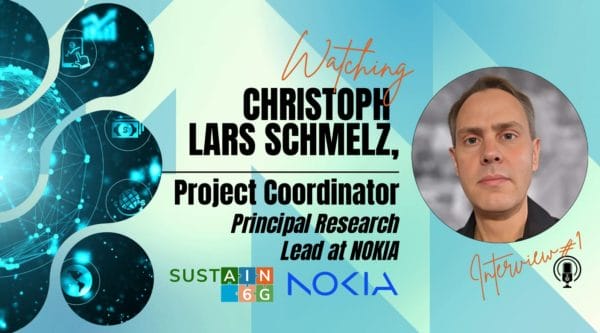
The transition to 6G is about more than faster networks—it is about building technology that supports a sustainable future, and the SUSTAIN-6G project is leading that effort. Coordinated by Christoph Schmelz from Nokia Munich, the project focuses on designing 6G systems that are energy-efficient, socially inclusive, and economically beneficial. As part of the Horizon Europe SNS-JU Sustainability Lighthouse, SUSTAIN-6G is developing a holistic sustainability framework, identifying key requirements for responsible innovation, and exploring real-world use cases where 6G can make a meaningful impact. |
If you are interested in how the next generation of connectivity could shape our society, the interview is online at: https://youtu.be/wk68zE4JTxE |
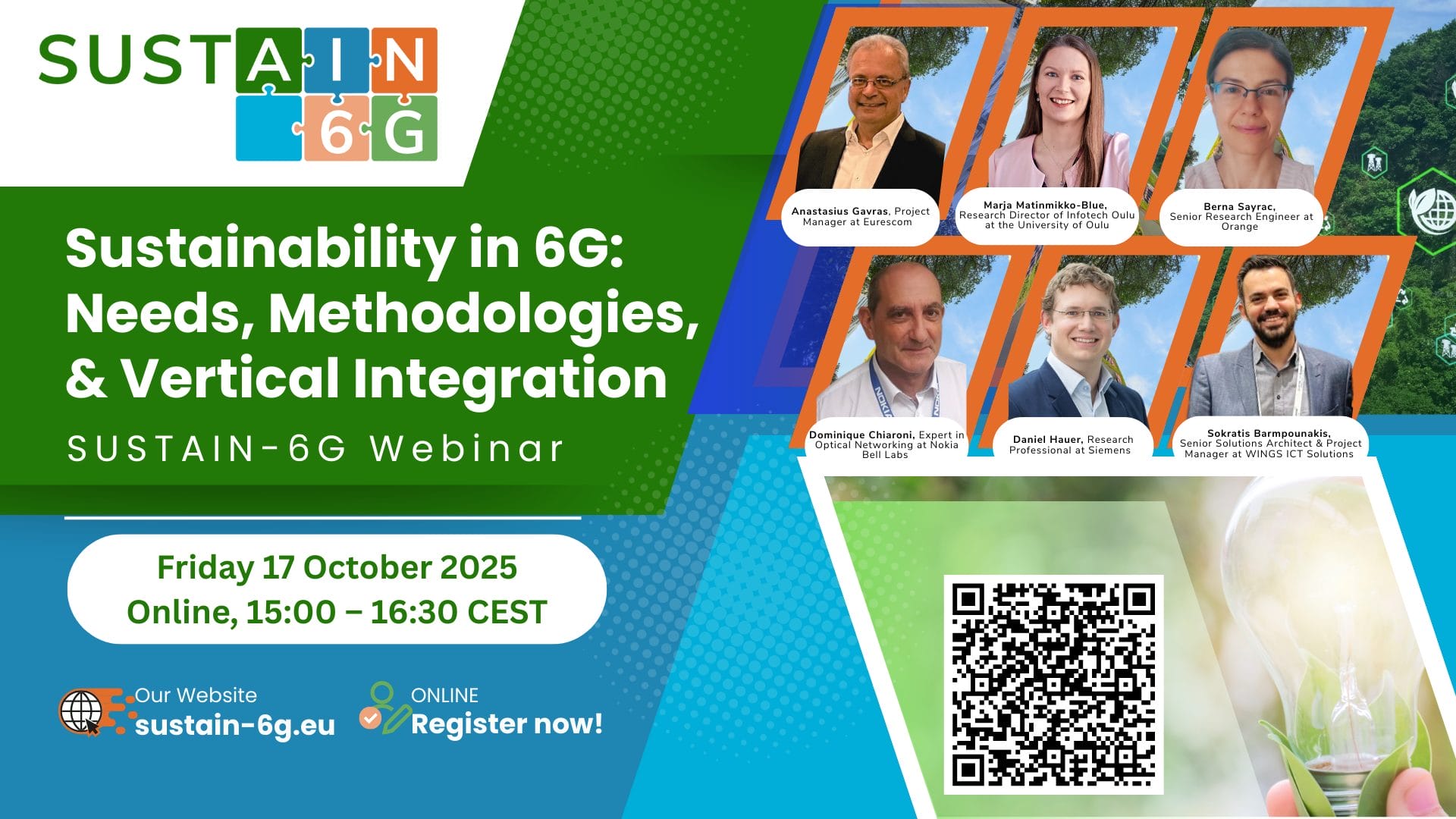
This webinar provided a comprehensive look at how sustainability can be integrated into the development and application of 6G networks, highlighting both the need to reduce environmental impact and the opportunity for 6G to enable positive change in sectors such as agriculture, healthcare, and energy. Bringing together perspectives from researchers, telecom operators, technology providers, and end users, the session introduced a shared framework for evaluating sustainability in 6G and emphasised the importance of designing networks that support environmental, societal, and economic goals from the outset. Through discussions on eco-design, circular economy principles, AI trustworthiness, and real-world use cases, participants gained a clear view of how SUSTAIN-6G is shaping responsible and future-proof digital transformation. |
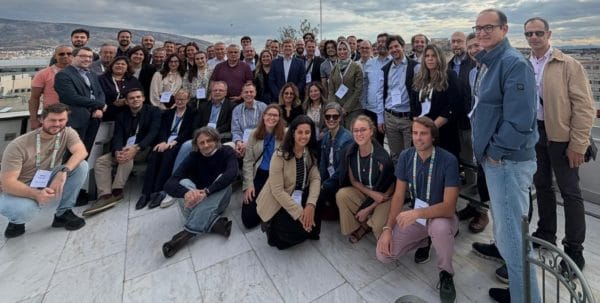
The third SUSTAIN-6G Plenary Meeting, hosted in Athens by WINGS ICT Solutions, brought the consortium together to review progress and strengthen collaboration toward building sustainable and future-ready 6G networks. Over three days, partners aligned on methodologies, refined sustainability assessment frameworks, coordinated proof-of-concept developments, and advanced work across key use cases such as Smart Grid, Agriculture, and eHealth.The meeting also focused on integration efforts, standardisation activities, and planning for upcoming deliverables and demonstrations. The event reinforced shared commitment, encouraged cross-team cooperation, and set a clear roadmap for the next phase of the project as it moves toward its next plenary in Ghent! |
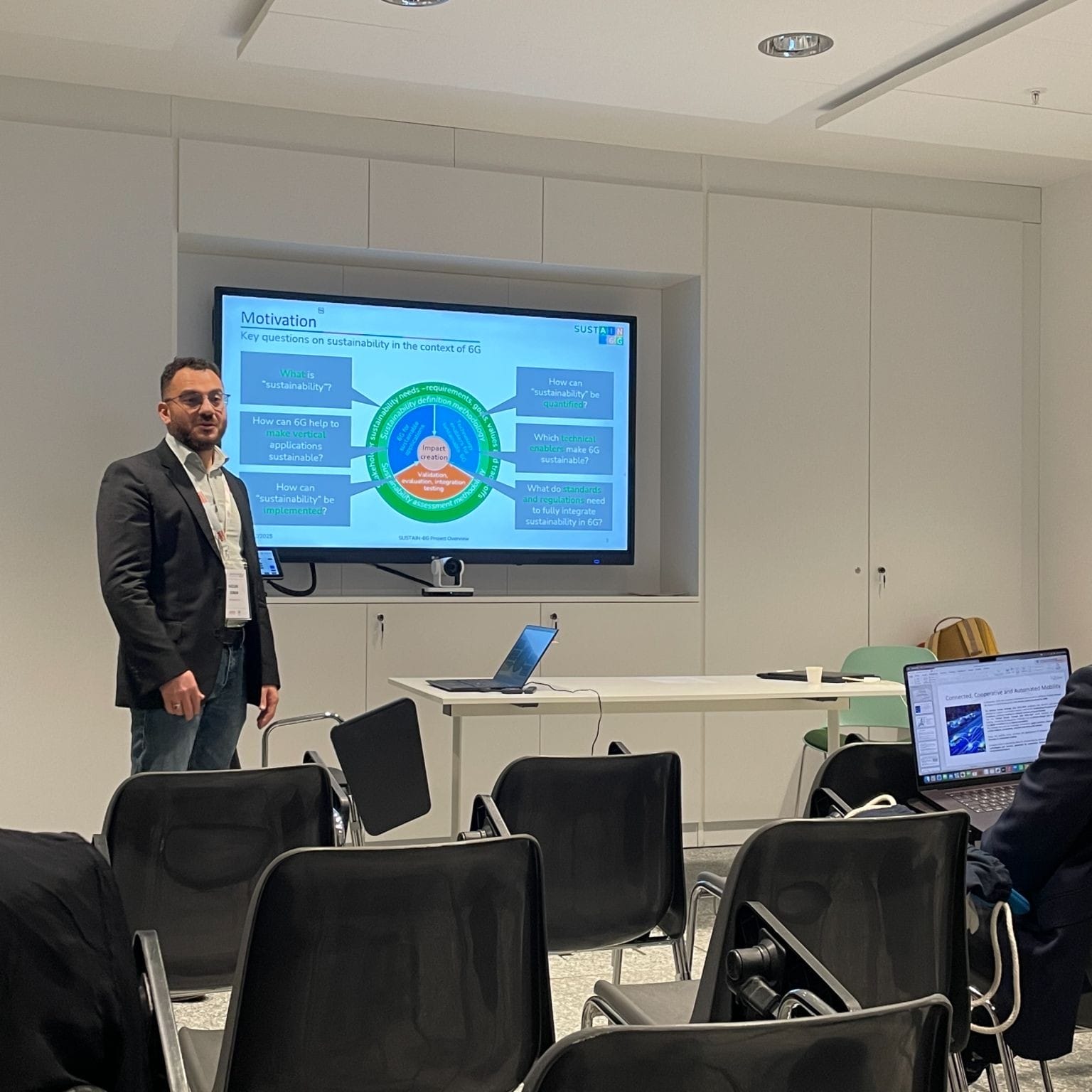
This second edition of the “Towards Sustainable 6G – Part II” clustering workshop continues the shared effort to shape greener and more energy-efficient future networks. Held during the Sustainable Places Conference in Milan, the event brought together experts from across Europe to discuss sustainability in areas ranging from Green Building and Energy to Sustainable 6G.
Dr. Hassan Osman (Real Wireless) presented the objectives and vision of the SUSTAIN-6G project during the “Towards Sustainable 6G” workshop, an important step in exploring how next-generation connectivity can align with broader sustainability goals. Through project pitches, moderated exchanges, and open networking, participants worked toward strategic alignment and practical actions for reducing the environmental impact of future communication infrastructures. The workshop reinforced a clear message: achieving sustainable 6G requires coordinated research, technology innovation, industry engagement, and policy support. |
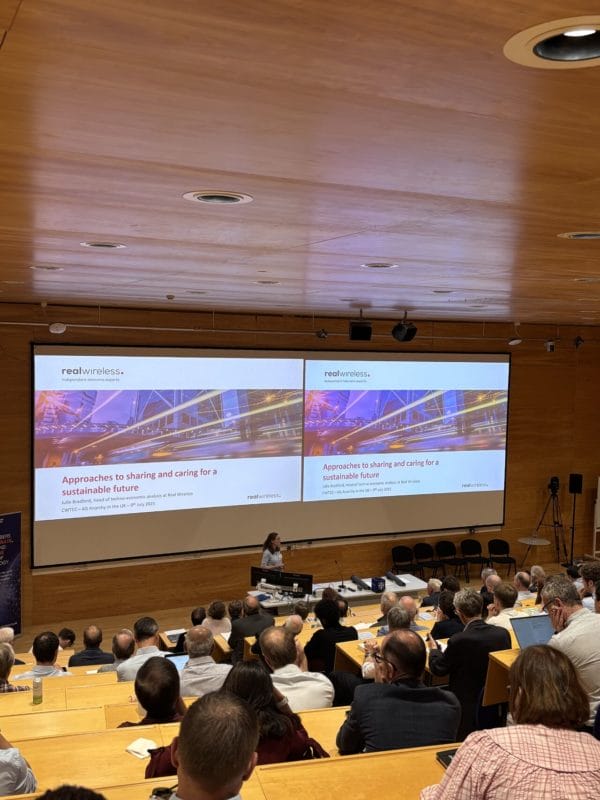
On 9 July 2025, SUSTAIN-6G was featured at the Cambridge Wireless Technology and Engineering Conference (CW TEC 2025) in Cambridge, UK, under the bold theme “6G Anarchy in the UK.” Julie Bradford from Real Wireless, representing the project, delivered the closing address highlighting the dual challenge of making 6G both commercially viable and sustainable. She emphasised the need to lay the groundwork now for energy-efficient, environmentally responsible, and socially beneficial 6G networks, drawing lessons from previous mobile generations. SUSTAIN-6G’s work across 24 partners in ten European countries demonstrates how 6G can support sectors like smart energy, agriculture, and healthcare while minimising environmental impact, reflecting the growing consensus that the UK’s 6G success requires balancing innovation, sustainability, and practical deployment strategies. |
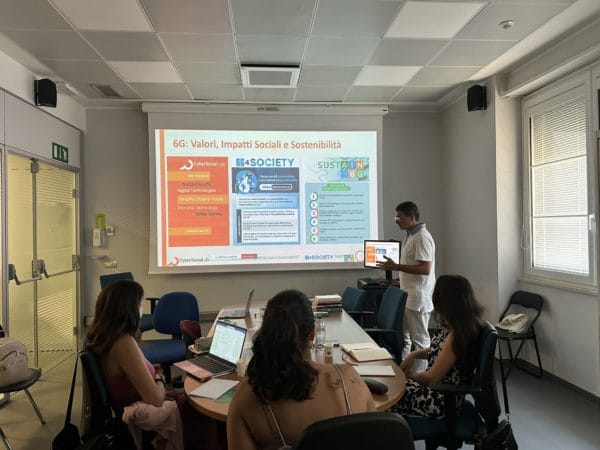
On 6 July 2025, CyberSocial Lab hosted a workshop at Università degli Studi Roma TRE for students from the Inter-University Master’s Program in Sociology, exploring 6G from social and ethical perspectives. Facilitated by Emanuela Tangari and Luigi Briguglio, the session sparked discussions on trust, digital inequality, citizens’ rights, and the responsibilities of technological innovation, culminating in a proposed set of core values—transparency, freedom, privacy, and human dignity—to guide 6G development. Presentations from the 6G4Society and SUSTAIN-6G projects highlighted efforts to align technical research with societal needs, marking an important step toward embedding social responsibility and sustainability at the heart of next-generation network design. |
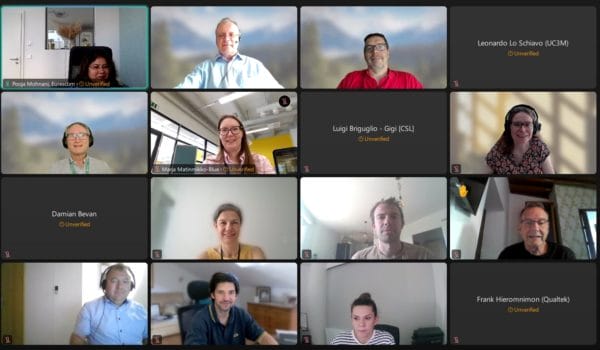
SUSTAIN-6G has held two successful meetings of its External Advisory Group (EAG), fostering collaboration with leading experts to guide the project’s strategic direction.
The first meeting on 19 June 2025, set the foundation with discussions on sustainability terminology, key values, and sectoral applications of 6G. The second session on 5 November 2025 built on this momentum, deepening exchanges on methodologies and cross-sector engagement.
Insights from the EAG continue to strengthen SUSTAIN-6G’s mission to embed sustainability at the heart of next-generation communication networks. Next meeting is planned in February in -presence to deepen collaboration and strategic impact |
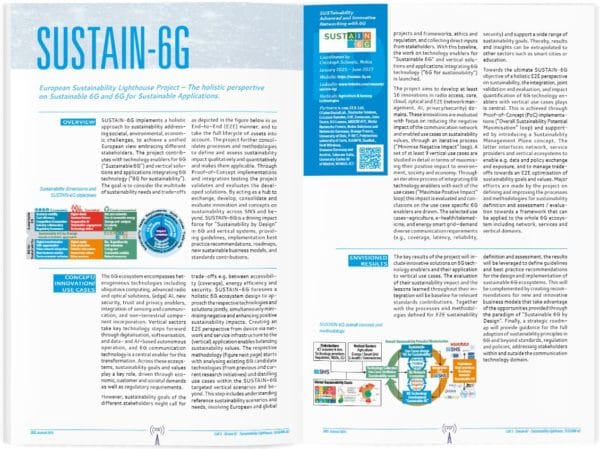
SUSTAIN-6G has been officially featured in the SNS JU Journal 2025, highlighting its role as the Sustainability Lighthouse project under Horizon Europe’s Call 3, Stream B. The project focuses on embedding sustainability holistically into 6G design, development, and deployment, addressing environmental, societal, and economic dimensions. Key activities include integrating 6G with vertical use cases, developing a Sustainability Management Plan for end-to-end operations, and shaping standards and policies for long-term impact. This recognition underscores SUSTAIN-6G’s commitment to advancing not only technical excellence but also resilient, inclusive, and sustainable digital infrastructure across Europe. |
Have questions or want to reach out? Feel free to email us at: info@sustain-6g.eu Stay connected with the latest updates on the SUSTAIN-6G project! Follow us on LinkedIn for all the news and insights: |
|
|
|
|
|
|