Workshop at Photoptics 2026 “Photonic Technologies for a Sustainable ICT”

On March 6th, 2026, within the framework of the PHOTOPTICS 2026 International Conference, co-chaired by Paulo Ribeiro (LIBPhys, Portugal) and Pablo Albella (University of Cantabria, Spain), we had the opportunity to organise a workshop entitled “Photonic Technologies for a Sustainable ICT.”
This workshop was co-chaired by Dominique Chiaroni (Nokia Bell Labs), Leif Katsuo Oxenløwe (DTU Fotonik), and Olivier Bouchet (Orange Labs). It featured four keynote speakers, three invited speakers, and four outstanding regular papers, illustrating the potential of photonic technologies for sustainable ICT systems. The workshop program was complemented by additional regular papers addressing relevant aspects of the workshop theme.
Introduction slides can be found here

During this conference, the Best Paper Honorable Mention was also attributed to a SUSTAIN-6G Paper entitled “Photonic Continuity: Sustainable Wired and Wireless Photonics from kilobits per second (kbps) to Petabits per second (Pbps)” authored by Olivier Bouchet (Orange Labs), Yanes Yahoui (Orange Labs), Guillaume Vercasson (b-com), Vincent de la Broise (b-com), Irene Kolokytha (WINGS ICT), and Sokratis Barmpounakis (WINGS ICT).
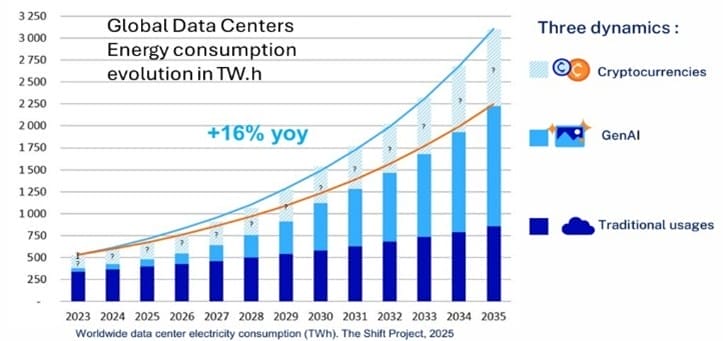 The objective of this workshop was first to provide context in order to better understand the energy challenges driving the need for sustainable approaches in the design of future products and infrastructures.
The presentation by Hugues Ferreboeuf from The Shift Project (https://theshiftproject.org/) highlighted the urgent need for a fundamental rethinking of current practices, emphasising the importance of integrating essential sustainability principles.
 Christoph Schmelz, project leader of the SUSTAIN-6G project (https://sustain-6g.eu/), presented a methodology for designing future 6G technologies within a sustainable framework. Beyond methodological considerations, the goal is to establish reliable metrics to evaluate the environmental impact of new products and to promote new standards encouraging sustainable design practices across the ICT industry.
The workshop also included a presentation of the GreenCOM Project (https://greencom.dtu.dk/), co-led by Niels Hersoug and Leif Katsuo Oxenløwe. This project investigates 30 innovative technologies, including 19 optical technologies, aimed at enabling greener ICT infrastructures spanning access networks, core networks, and data centres.

Several speakers from this project highlighted key results, including the all-optical conversion of a shared TDM resource into dedicated WDM resources, aligned with the emerging business paradigm shift “from Speed to Quality of Experience.” Another contribution proposed WDM-based parallelisation of optical transmission systems, significantly reducing the number of EDFAs required for a given transport capacity—an approach particularly relevant for submarine communication systems.
One paper analysed the environmental footprint of the different phases in the lifecycle of an optical fixed network, from raw material extraction to recycling processes. This work demonstrated a methodology for quantifying the environmental impact of each stage in the lifecycle of network infrastructures.
Another contribution presented new solutions for intra-data-centre interconnections: a microcomb split into 4096 SDM channels and, by using the most lossy branch, a 44.6 Tbit/s capacity was measured distributed over 245 WDM channels with a total estimated capacity of 182.5 Pbit/s. A further paper introduced a low-power quasi-coherent optical transceiver, offering promising perspectives for reducing the energy consumption of optical communication systems.
 We also had a presentation by Marc Fleschen, General Chair of the Light Communications Alliance (https://lightcommunications.org/), highlighting the potential of optical wireless communication technologies for in-building applications. His talk showed that the combination of optical wired and wireless communication technologies can lead to significant energy savings compared with traditional Ethernet switch-based network architectures.
Sensing technologies were also addressed as an important component of sustainable infrastructures, offering new possibilities for energy-efficient and intelligent systems and networks. Cedric Ware presented the importance of digital twin technologies for identifying optimal solutions in real-world deployments.
We also welcomed a presentation by Lieven Levrau from the IOWN Global Forum (https://iowngf.org/), who discussed the major challenges ahead and the need for global collaborative initiatives to address them within the framework of next-generation optical networking technologies.
The workshop concluded with a round-table discussion chaired by Dominique Chiaroni, during which leading experts shared their perspectives on the top priorities that must be addressed to build a truly sustainable ICT ecosystem.
Conclusion slides can be found here
The workshop Co-Chairs would like to thank the General Chairs of the PHOTOPTICS 2026 International Conference for providing the opportunity to organise this workshop and foster scientific exchanges on this important topic. We also extend our gratitude to INSTICC for their continuous support in the organisation of this event.